Master of Entrepreneurship graduate Louis Razuki’s journey from uncertain commerce grad to sought-after consultant shows how curiosity can lead to career fulfillment. Louis has found his purpose helping mission-driven organisations scale sustainably, cutting through inefficiencies so they can do better what they do best.
At 22, Louis Razuki was a newly minted commerce graduate, but had no idea what to do with his life. His uni friends were rushing into traditional graduate jobs, but Louis wanted to work for himself. He’d already started a tutoring business and wanted to expand it, but didn’t know where to begin.
“I’ve never had a big picture,” says Louis. “Everyone else was like, ‘I want to be a partner at this firm’ or ‘I want to build this business that’s going to reach this market cap.’ I’ve never cared about any of that. I’ve just been following my intuition.”
That intuition led him in 2017 to University of Melbourne’s Master of Entrepreneurship program, co-delivered by Wade Institute, where he became part of the second cohort. During that first year, as Louis developed his entrepreneurial skillset and a community of new, like-minded friends, he decided to close his education business and explore other industries.
The program proved to be a “really meaningful” experience that would shape his entire career philosophy – a priceless opportunity to put startup methodology into practice. The “build, iterate, learn” approach became a core principle Louis has carried throughout his life:
“I’d far rather whip up a quick prototype and show someone, ‘This is how it could look,’ rather than get caught up in proposals and then trying to build the whole thing at once.”
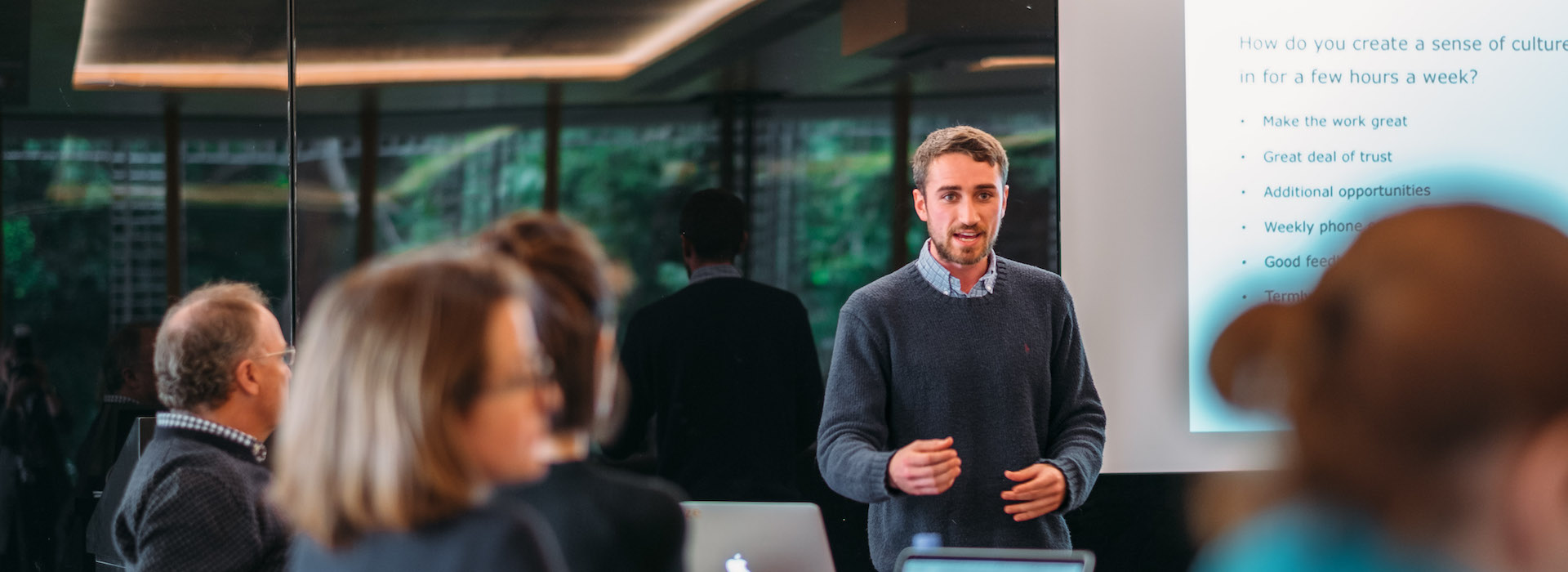
Louis also discovered first-hand the persuasive power of narrative. “We did so many pitches – in every single subject you were presenting, taking a concept and having to convey it in five minutes or less,” he recalls. “That training around storytelling has played such a huge role in my career. It’s not about what you put on the slides, it’s the story that you weave with it.”
Discovering His Superpower
Through various roles in education, theatre, tech, startups and non-profits, Louis began to notice a pattern. Everywhere he went, he found himself drawn to the same challenge: messy data, inefficient systems, and the gap between strategy and execution.
“I’d go in and be like, ‘The data’s a mess, I can’t make sense of it. Do you want me to clean it up?'” he explains. “In every role, there’s been a big before-and-after story.”
Eventually he had his eureka moment: he could be the bridge between strategy and execution. “I can sit with leadership, understand what we’re trying to achieve, come up with an architecture of how we’re going to do that, and then actually deliver it,” Louis says.
“Usually people are either technical or strategic – being able to bring those two things together is my unique edge.”
Defining Success for Himself
Louis recently launched Lituus Consulting, working primarily with purpose-driven organisations. He’s currently splitting his time between two non-profits, ygap and Children’s Ground, supporting them in their digital transformations.His people-first approach to systems design is deeply collaborative. He sits in offices, gets invited to Christmas parties, and works alongside teams to overhaul their operations.
“There’s so much context you get from being in the weeds,” he says. “People want to feel heard and people want to feel seen, and bringing that concept into technology is really important. My impact is about creating structure and spaciousness for other people – I help carry that load for them. That’s what I find really gratifying.”
Louis has consciously chosen not to scale his consultancy into an agency. Instead, he’s focused on becoming an expert at what he loves: swooping into organisations, identifying inefficiencies, and implementing solutions that free up people to do meaningful work.
“I want to do the improvement, the change, the strategy and the execution,” says Louis. “I didn’t know where I could find a role like that, so I created it for myself.”
The Master of Entrepreneurship Legacy
Looking back, Louis credits the Master of Entrepreneurship with giving him both the practical skills and the entrepreneurial mindset to forge his own path. The program’s emphasis on rapid prototyping, storytelling and iterative learning didn’t just teach him how to start a business – it taught him how to continuously design and redesign his career based on his evolving understanding of what brings him joy.
For someone who started with no clear direction, Louis has found remarkable clarity. He’s proof that sometimes the most fulfilling careers aren’t planned; they’re discovered through curiosity, experimentation and the confidence to keep iterating until you find what works.