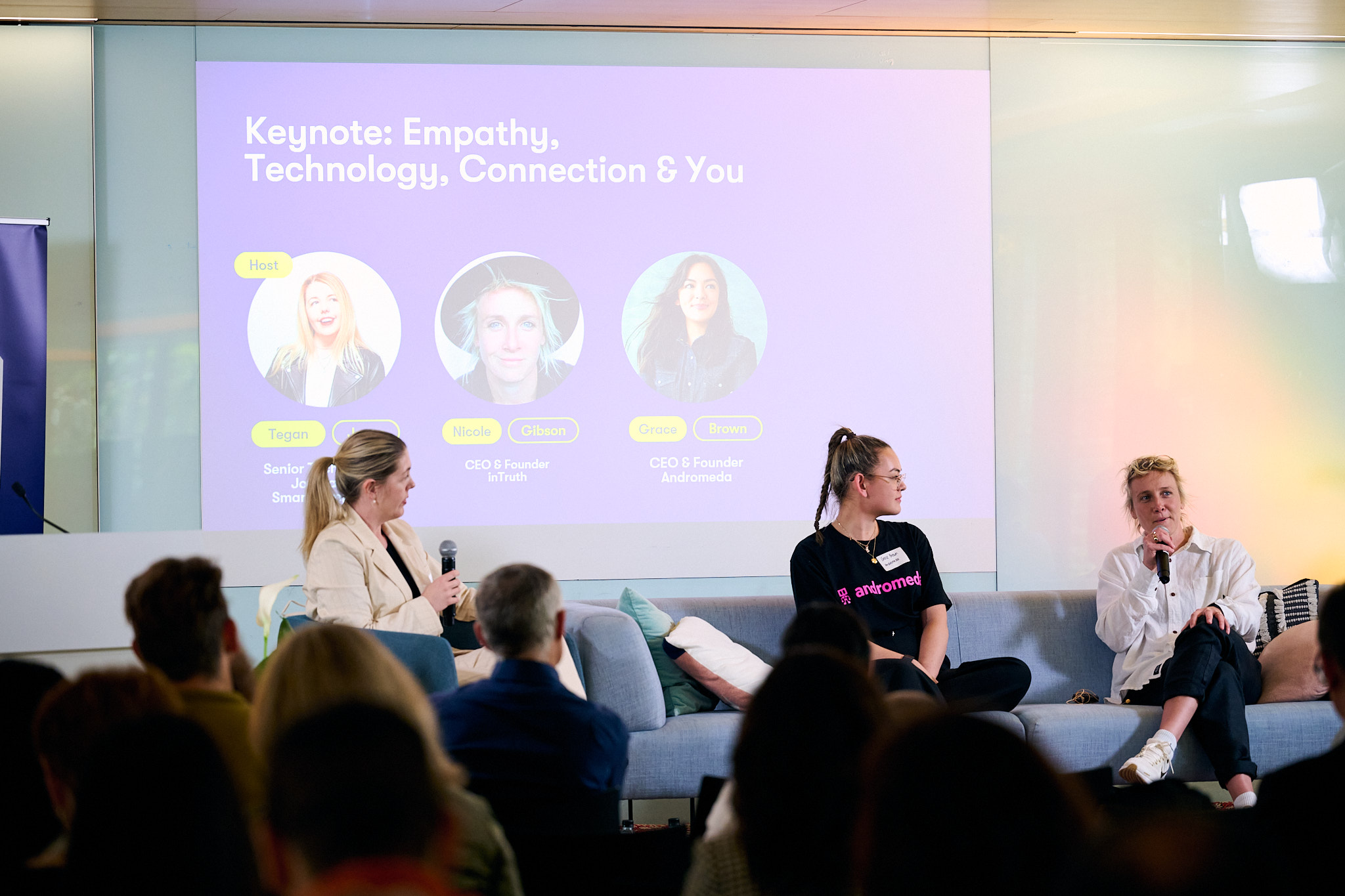
Assembly 2024’s keynote panel discussion, “Empathy, Technology, Compassion and You”, featured two founders who are infusing ground-breaking innovations with emotional intelligence: InTruth’s Nicole Gibson has found a way to measure emotions through consumer-grade wearables, while Andromeda’s Grace Brown has designed a humanoid companion robot for nursing homes and hospitals. Their products, they believe, could lead to a more connected future.
Mechatronics engineer Grace Brown likes to call Abi – her 110cm-tall humanoid robot – “your best friend, right out of the box”. Described as the first companion robot programmed with empathy, Abi is already in Australian aged-cared homes, easing the social isolation of the elderly people who live there – 40 per cent of whom never receive visitors.
In one recent, memorable encounter, Abi empathised with a resident over the loss of his best friend.
“None of that was pre-programmed,” said Grace, the CEO and founder of Andromeda. “The nurses were crying because it was one of those really raw moments created with Abi that otherwise would have been filled with loneliness and disconnection.”
Speaking on the keynote panel at Assembly 2024: A VC Catalyst Conference, Grace joined former federal mental health commissioner Nicole Gibson to discuss how their startups are weaving emotion into technology. The CEO and founder of InTruth Technologies, Nicole explained how her software company is the first in the world to track emotions via consumer-grade wearables, and could improve our emotional insight at a societal level.
Understanding emotion
“Emotions drive 80 percent of our decision-making and … it’s largely unconscious,” said Nicole. “[We’re] giving people a voice that they’ve never had. I think many of us feel degrees of being misunderstood and have levels of pain, not being able to really express what we feel.”
The technology could, for example, detect PTSD in emergency workers, or help someone understand their relationship habits. “There are a lot of B2B applications,” she said, “but InTruth is a consumer-first product – I want to develop a product that everyone wants to use.”
When choosing investors, Nicole said she opts for those who care about the company’s story, are likable, and have the mindset to help solve roadblocks as they arise:
“I like to ask the question, ‘Do I want to make this person rich?’”
According to Nicole, potential investors need only see their own InTruth data to be convinced of the technology’s value.
Managing data security risks
That information is highly sensitive, of course, which raises privacy concerns; InTruth protects information by storing subsets of data in different servers. Nicole noted that, unlike institutions that rely on centralised servers, startups are in a unique position to innovate.
“The future of health data in an ideal world,” she said, “would look something more like an encrypted wallet you carry, giving the consumer a complete sense of sovereignty and autonomy over who that data is shared with.”
Both Nicole and Grace ultimately have global ambitions, but the Australian market for Abi is much larger than in the US because of the higher cultural value placed on quality aged care here, as well as tax incentives.
Building on a budget
Ever-evolving, Abi is modular and customisable, with different personalities tailored to specific customers, including Philosophical Abi and Christian Abi. Grace built the first prototype with a $300 3D printer when she was still a student. Early on, VCs were concerned about expensive hardware, but Grace said costs have dropped dramatically in robotics: an Abi that would have cost $100,000 less than 10 years ago can now be made for a tenth of that price – and will cost less than an iPhone to manufacture a decade from now. “We recoup the cost of one Abi, including labour and everything, within about six weeks of having her out in the world,” she said.
Grace likened Abi to the Ford Model T, the first affordable, mass-produced car that changed America. Like Nicole, she predicted her innovation would have a similar transformative effect on wellbeing and connection.
“People don’t see [Abi] as a technology product or even as a robot – they actually see her as a true friend,” said Grace.
“If we don’t show up the way we need to, it’s not that we lose this contract, we don’t make our investors rich or the company dies, it’s that Jim and Albie don’t get a visitor that day … It’s a huge responsibility, but it’s one that we’re really excited to take on board.”